about ian bullock


about Ian - his own words
Since the 1970s I have been working – whenever I have had the time (and energy) – on what to me seems a question which is both fascinating and important – the relationship between socialism and democracy in Britain. I say, in Britain, because that's what I've worked on – but, of course, my interest, and the implications of my work are not confined by national boundaries. (see for example the 1987 article mentioned below.)
In 1981 I completed, as a part-time research student, the doctoral thesis, 'Socialists and Democratic Form in Britain, 1880-1914: Positions, debates and conflicts'. The D Phil at the University of Sussex was awarded in 1982.
I attempted in the '80s to get the work published - but lacked the necessary perseverance. Meanwhile, in 1987 a joint article with Sián Reynolds 'Direct Legislation and Socialism. How British and French Socialists viewed the Referendum in the 1890s' was published in History Workshop Journal 24 Autumn 1987.
I then edited, with Richard Pankhurst, Sylvia Pankhurst. From Artist to Anti-Fascist (Macmillan, 1992). This includes my own chapter 'Sylvia Pankhurst and the Russian Revolution: The Making of a "Left-Wing" Communist.'
The substance of my thesis was finally published, together with chapters on the trade union aspect of democracy from Logie's work, in Logie Barrow and Ian Bullock Democratic Ideas and the British Labour Movement, 1880-1914 (CUP, 1996).
My book Romancing the Revolution. The Myth of Soviet Democracy and the British Left was published by Athabasca University (AU) Press in 2011 and the same publisher brought out my book on the ILP in the 1920s and 1930s, Under Siege, The Independent Labour Party in Interwar Britain in 2017
It has long seemed to me that some people on the Left who take any interest in history seem often to be motivated more by a search for "correct" policy and to identifying those who behaved in what they think was the "right" way than in attempting to understand how and why events came about the way they did and exploring the thinking and the feelings of those on all sides of the debates and conflicts which contributed to this. My intention is always to try to help us all to understand how people came to the conclusions they did, what they actually believed, and why they acted as they did. The mentality that insists on sitting in judgement on the past obstructs rather than enhances our understanding of it.
One always wants to know where historians are 'coming from' – particularly in the case of such politically sensitive and controversial areas as the ones I'm concerned with. This seems to me a very legitimate concern.
I have never considered myself a political activist. My only sustained – but low profile – activism was in my trade union, (then) NATFHE, in which I was, for example, one of the delegates of its South East Region at all – or nearly all – the annual conferences in the 1970s and 1980s. The only political organisations – leaving aside the usual single issue campaigns – that I have been a member of are the Labour Party (1964 to the present) and, in the late 1960s, the May Day Manifesto Group. .I was also involved with Voice of the Unions in the 1970s.
Writing Under Siege brought me in touch with the ILP, I became a ‘friend’ and wrote a few short pieces for their website which will be found on at https://www.independentlabour.org.uk
Ian Bullock
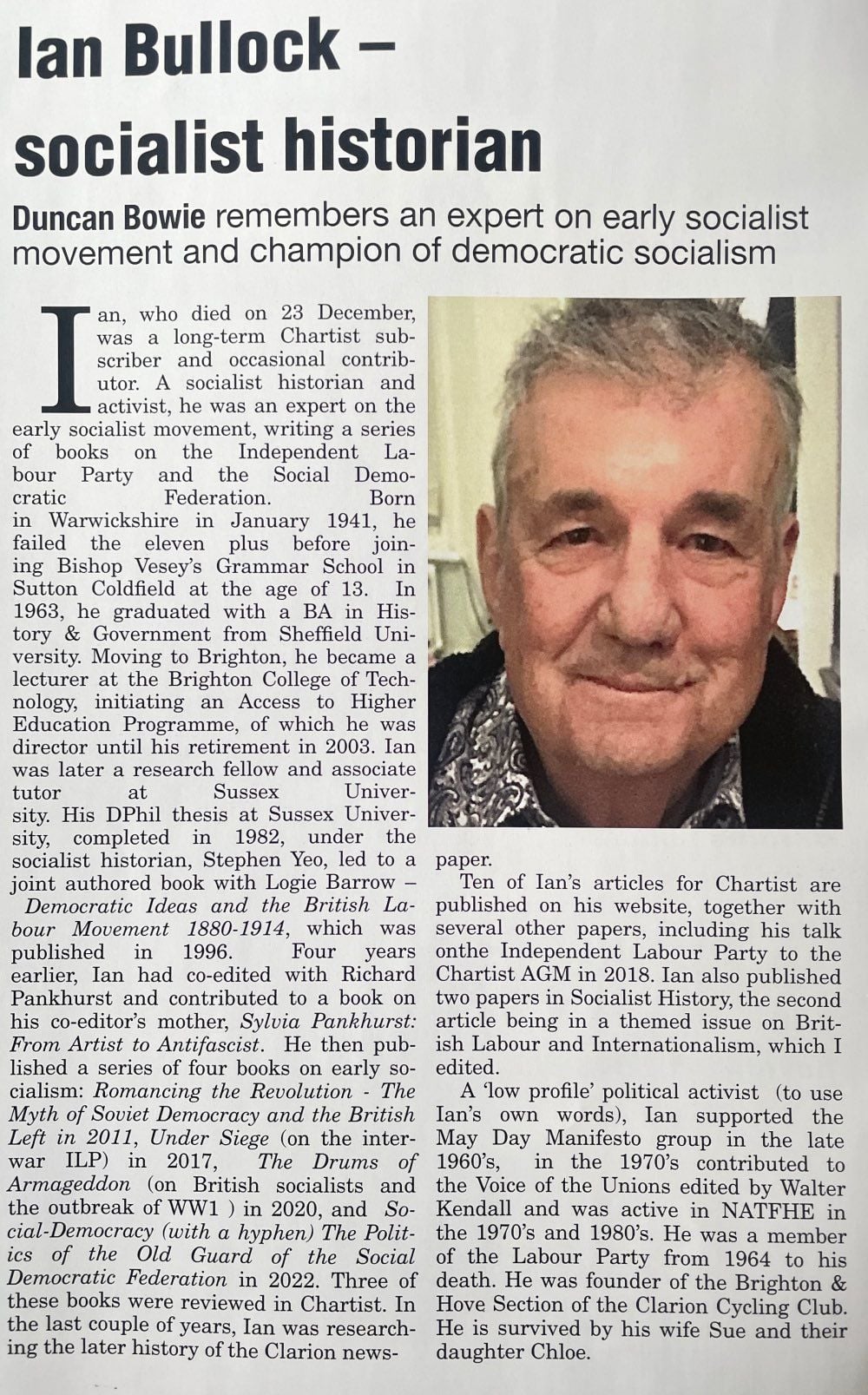
Sadly we lost Ian on 23rd December 2025.
He clearly helped and influenced many people. We've been sent very many beautiful dedications and we'd like to share some of them see below.
About Ian, by others
Ian Bullock Memorial, 17th January 2026, University of Sussex
Sian Reynolds - January 2026
The work Ian and I did together was comparative about the socialists who favoured direct democracy and referendums in the 1890s, in both Britain and France. Ian’s speciality was the group around Robert Blatchford and the Clarion paper who were forerunners of the ILP, and ‘Dangle’ was the pseudonym of Alex Thomson, who had links with the French ‘Allemanists’ on whom I did my thesis. We jointly authored an article in History Workshop Journal on this in number 24 Autumn 1987.
Ian was very modest, too modest, but he was also very articulate as someone who believed strongly in a socialism that was quite prepared to call itself socialism, and that was social, and democratic, and left-wing, without veering too far to either the right or left. His article about 'Jeremy Corbyn the accidental leader’ was extremely generous and sensible - I have just been re-reading it online. He was really the one of my old friends from Brighton with whom I found it easy to agree, which was incredibly comforting in all the years we have been through - and look where we are again! His books about the ILP, the USSR, and Sylvia Pankhurst, are all important and unique, coming at the topics from a really fresh perspective.
Logie Barrow - January 2026
Impossible Goodbyes
I began to know Ian seriously when functioning as external examiner on his doctoral thesis in 1982. Even the happiest such occasions are, for candidates, nerve-racking. But within months he and I were vaguely, soon seriously, working out how to combine our researches into one book on democratic strivings and confusions among British socialists and trades unionists into the 1910s. Our discussions soon became detailed. He quickly turned out to be a marvellous collaborator, always open to frank feedback and happy to give it. Cambridge University Press published our resulting volume in 1996.
From then on, he rightly took the story into the post-1914 decades, where there were all too many rich developments, mostly negative: needless to say, there still are. By contrast, I waded into a bog of what I now call “stupefaction”: intellectual de-skillings and enclosures of knowledge, not least medical, interacting more or less directly with changes in social relations of production.
Of course, there are also re-skillings, and —surprise, surprise -- Ian exemplifies these well. His initial status as a working-class “11+ failure” seems to have reinforced in him a quietly defiant adaptability. True, my merest instincts suggest how vitally those closest to him strengthened that. But all I know is, he combined openness with a happy argumentativeness and irony. Over decades, those qualities surely flourished amid his activism in and around the Labour Party and his union. I imagine, from the outside, that they also prospered amid his beloved world of cycling. (Am on “the outside”, as my own marginal research on the pre-1914 Clarion Cycling Clubs has now had 50 years to grow stale).
Altogether, the more the last few centuries' social and international relations have channeled the 1960s' hope of cybernetically-winged 'from-belowness’ into Trumpery-Musk-ovy, the more politically Ian’s voice will be missed.
Let alone personally.
Tony Carew - January 2026
Tribute to Ian
My memories of Ian are very similar to those expressed by Victor since we met him at the same time, had a common link to Sussex University and the three of us were all deeply immersed in helping to edit and distribute the left radical paper Voice of the Unions.
That first meeting, arranged by our mutual friend Stephen Yeo, took place at the King and Queen pub on the Steine. I didn’t know what Ian looked like and as we both arrived early we found ourselves standing at the front door of the pub scanning faces and probably looking like a shifty pair of bookies’ runners on the lookout for the police.
We agreed to form a “Brighton Group” to help Voice out by soliciting articles for its back page and then editing it. We tried to get local people to write - mostly they had never written for a paper before. Our Brighton Group met once a month in Ian’s house and that’s where we got to know Sue and little Chloe - and two cats called Bumble and Willow.
One Friday evening a month we also nipped up to London on the train for the meeting of the overall Voice editorial board. Those were days when on the Brighton Belle you could expect to see the boxing promoter Jack Solomons or the radio personality Wilfred Pickles eating the speciality - kippers. The return fare was 19/11d I recall.
As Chloe’s dad, Ian’s work for Voice and his parenting duties sometimes clashed. On one occasion we went to Hastings to distribute copies of the paper outside a TUC conference. Ian was in charge of Chloe that day and brought her along in her buggy. As the delegates streamed into the conference hall and we handed out papers, Vic Feather, the general Secretary of the TUC strolled up. He was a VERY IMPORTANT FIGURE at that time and he looked at us a little warily when offered a paper. But then he looked down and saw Chloe in her buggy holding out a copy. So he patted her on the head, accepted her copy graciously and stood to chat for a while. I don’t know how old Chloe was then but the Conference was in May 1973 - so she’ll know.
I learned from Ian another spect of parenting around then. He and Sue were part of a baby-sitting group who took turns at minding each others’ kids. The system worked on tokens - so for someone minding Chloe you paid them in tokens which you earned when in turn you looked after someone else’s child. But then the shocking discovery - someone in the group was paying with counterfeit tokens and not earning them by doing their share. I can’t recall whether or not the group survived that crisis.
In those days Ian was very much an outdoors man. I enjoyed walks with him in the Downs. I discovered Alfriston and Bo Peep with him that way. We always stopped for a pub lunch in The Star or The George.
I also remember Ian as a big cyclist and a founder of the Brighton Clarion Cycling group. Later on when I had moved up North he called at our house part way through a big cycling tour of England. My kids were astounded when he told us his next stop was going to be Nottingham - about 70 miles away. He was big fan of the Tour de France and used to go to Paris each year to watch the cyclists cross the finishing line on the Champs Ellysee. He went so regularly that he befriended a French enthusiast after seeing him so often standing in the same place at the same time.
Ian was very knowledgeable about jazz but I sadly disappointed him when once I took him to my pub to hear my favourite local Trad Jazz group. I don't think he was impressed. And he positively drew the line at Clinton Ford singing “Fanlight Fanny, the Frowzy Night Club Queen”. Definitely not jazz, he said - even if there was a bloke in the band blowing a trombone.
Apart from work on Voice of the Unions, he and I collaborated on more than one publication. In a chapter intended for a book on the Future of Socialism, the editor raised an objection because it included an unflattering passing reference to Leon Trotsky. It wasn’t central to our argument and we could have satisfied the editor by leaving one or two words out. But it was Ian who insisted that a principle was at stake, so we withdrew the whole offering rather than make this change - and our writing never did see the light of day.
Ian introduced me to Yugoslav workers self-management a subject in which he took a special interest in the 1970s. I seem to recall that he and Sue used to go there for holidays and told me that you could enjoy a nice Christmas there without all the jingle bells stuff. I perked up at that. And later on I was happy to arrange for Ian to give a fascinating talk on the Yugoslav system in what was then the Sussex Centre for Contemporary European Studies - just a few yards from here.
Victor has noted how influential Walter Kendall was on Ian - and is a tribute to Ian and Sue that they kept in touch with Walter and visited him a number of times in his final days when he was housebound.
Ian spoke eloquently at a memorial event for Walter - and again his meticulous attention to scholarly detail was on display. Someone else present challenged something Walter had once written. But Ian wasn't having any of it and in his usual calm, polite way explained why Walter had been perfectly right. The memorial meeting became something of a teach-in - which Walter would have been very pleased with.
I am glad to have known Ian - a true, scholar, trade unionist, Socialist - and friend.
Victor Rabinovitch - spoken Ian's memorial, 17th January 2026
It is a sad honour to be speaking here today. An honour, for sure, but I’d much rather be talking WITH Ian instead of talking about him.
For over more than 50 years, Ian and I shared so many conversations, debates and activities together. We met in late 1971 when I was at Sussex University. My studies then were taking a back seat to the work I did with the union and Labour rank-and-file newspapers known as Engineering Voice, and Voice of the Unions. These were closely associated with was called the "Broad Left". They were edited by a great character, Walter Kendall, who also became a very special friend to both Ian and Sue.
At that time, the work at Voice needed more volunteers. This is where Ian came in. It was Stephen Yeo who introduced us. He underlined Ian’s work in Further Education and Ian’s belief in education as a force for betterment and social change.
We met, and talked, and laughed, and began to collaborate. Ian was five years my senior. He was already married to Sue, and she welcomed new friends and enthusiasms into their Bonchurch Street home. Young Chloe completed their household, together with two friendly cats.
A mixture of idealism and love of writing attracted Ian to our collaboration. He combined a deep respect for learning with a deep distrust of top-down hierarchy - especially in the Leninist model of command and control.
Ian was a natural fit for Voice newspapers and its leader, Walter Kendall. A word here about Walter. He was boisterous and brilliant iconoclast. He had been a union activist, well-read, who eventually graduated from Oxford as a mature student. Walter became a great mentor for Ian
Two other friends of Ian and Sue at that time stand out in my memory. Tony Carew came from Manchester, via Ottawa, Canada. He also was studying at Sussex, after a long stint as Head of Research at a big railway union. And then we were joined by Patric O’Reilly. Patric was a self-proclaimed anarchist and Labour activist who could cheer up any gathering with laughter, stories and a well-honed disrespect for pretensions.
These new friends, and others, made up our expanded team. We enjoyed lots of hospitality at Bonchurch Road, often lubricated by Ian’s powerful home brew. We talked, wrote and helped all aspects of Voice newspapers and related activities.
Ian stood out for his thoughtfulness, his scholarship, and his reliability. He was sharpening new ideas on democracy and socialism. These eventually shaped his ground-breaking books on grass-roots democracy, resistance to war, and on democratic socialist alternatives within the labour movement.
Ian, at that time, also asked himself how he could shift his own work and career. And specifically, should he leave full-time work in Further Education to pursue a new career in research and writing ?
These weren’t idle questions. Ian’s outlook was lively and immediate. He believed that moral alternatives were essential in both personal and professional life, and especially in politics. Choices must be made. But he was not a purist. He also accepted that compromises are made in organizations or in relationships.
A strong set of values are at the heart of Ian’s books and articles, written over more than a thirty year span. Just look at the titles found on his website or with a library search - and take time to read.
In his friendships and his writing, he was both serious and cheerful, pragmatic and idealistic. He argued for a Britain of greater equality in power and wealth, with room for leisure and pleasure, and with greater respect between all ethnicities. I stress this last point because the topic of prejudice came up often in recent discussions.
Let me conclude with words on Ian's family. He expressed such pride in Chloe’s success as a leading commercial designer who insists on care and ethical behaviour towards the entire environment. He was vocally appreciative of Sue for her liveliness, endless support, and courage. He spoke to me warmly about Paul, who has been a relatively new member of the family.
Ian was always generous in his love of scholarship. He was involved in community activities, in visiting distant places ( including Canada) and meeting people, in participating cycling and sport, and in love of music. He was always modest while sustaining his commitments and his tenacious search for ethical choices.
He has been our very good friend. Thank you, Ian.

While I'm adding these wonderful dedications about my lovely Dad, I thought I'd like to share this podcast interview from November 2024 after my own book launched. My friend, the interviewer Paul really got into my upbringing and I spoke lots about my parents. I'm so happy Ian got to hear it.
While Sue says I made it sound like they were organised and had a plan - well, I feel like they did. I hope you enjoy it.
P.S. Sue says I accidentally promoted her by incorrectly describing her last role for the University of Sussex, so **correction** she was Administrative Head of the Maths & Physics school.
CHLOE BULLOCK
The Rt Hon. the Lord Bassam of Brighton - 20th January 2026
Chloe, I thought that the memorial for Ian was wonderful on many levels with lovely tributes and kindness.
I really liked your dad, he was the best of us and warm and generous as are you and Sue. My many hours in Ian's company were well spent. He and Sue were generous too with their time when I was battling with members of the Labour Party who were not its best advocates.
Give in memory of Ian
Should you feel like making a donation in Ian’s memory, below are initiatives he supported.
Amnesty UK https://ianbullock.muchloved.com/
Cancer Research UK https://fundraise.cancerresearchuk.org/page/ian-bullock
Led By Donkeys https://donate.ledbydonkeys.org/donate#oneoff